Runes Stamps- Lower Case - Digital Download: A Practical Guide to 3D Printing and Usage
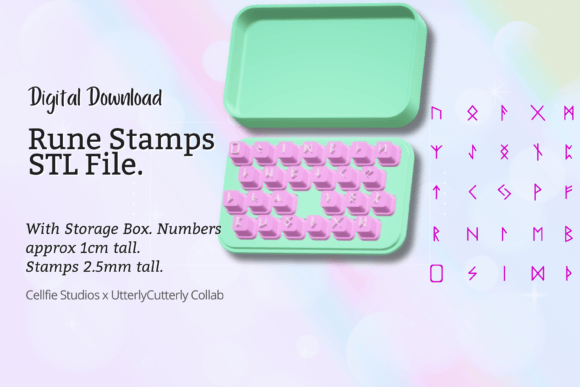
Unlocking the potential of personalized crafting often comes down to having the right tools at your fingertips. The Runes Stamps- Lower Case - Digital Download offers a versatile solution for creators, bakers, and artisans who own a 3D printer. This digital package provides STL files for a complete set of lower-case rune stamps, along with a custom storage box designed to house all 25 pieces. Whether you are imprinting polymer clay jewelry, decorating shortbread cookies, or adding texture to ceramic projects, these files allow you to manufacture professional-grade tools in your own home.
However, owning the file is only the first step. Many users encounter frustration not because the design is flawed, but because they overlook specific printing parameters or material safety considerations. Understanding how to properly configure your slicer and select appropriate materials will determine whether your stamps are durable, safe, and aesthetically pleasing. This guide addresses common oversights to ensure your digital download translates into high-quality physical tools.
Optimizing Print Settings for Fine Detail
The most frequent mistake when printing small functional items like rune stamps is prioritizing speed over surface quality. While the recommended settings for this file suggest a print speed of 150 mm/sec with a 0.4mm nozzle, treating this as a universal rule can lead to poor results. High-speed printing on entry-level machines or printers without input shaping often causes ghosting or layer shifting, which ruins the intricate lines of lower-case runes.
If your goal is legible, crisp impressions, consider slowing your outer wall speed to 40–60 mm/sec while maintaining higher infill speeds. The 0.4mm nozzle is standard and efficient, but if you find the rune details are merging or lacking definition, switching to a 0.2mm nozzle for the stamp face alone can dramatically improve clarity. Always run a calibration test specifically for small text before committing to printing the full set. A failed test print costs pennies in filament; a failed full set costs hours of time and post-processing effort.
Layer Height and Orientation Matters
Another overlooked detail is layer height selection. Printing at 0.2mm or higher may be fast, but it creates visible stair-stepping on the curved edges of runes. For stamp faces, a layer height of 0.12mm or even 0.08mm provides a much smoother finish that requires less sanding. Additionally, ensure the stamp face is printed against the build plate. Printing the face upward introduces support structures that leave scarring on the working surface, rendering the stamp unusable without extensive repair.
Material Safety and Food Contact Considerations
A critical misunderstanding involves using 3D printed stamps directly on food. Many creators assume that because PLA is derived from corn starch, it is inherently food-safe. This is a dangerous assumption. Standard PLA filaments often contain colorants and additives that are not certified for food contact. Furthermore, the FDM printing process creates microscopic layer lines that harbor bacteria and cannot be effectively sanitized.
If you intend to use these rune stamps for cookies or fondant, you must take corrective action:
- Use Certified Filament: Only use filament explicitly labeled as food-safe and FDA-compliant.
- Create a Barrier: Place parchment paper or food-grade silicone between the stamp and the dough. This allows you to use standard PLA safely while still achieving a clear impression.
- Seal the Surface: Apply a food-safe epoxy resin coating to the stamp face to fill layer lines and create a non-porous surface. Note that this adds thickness and may slightly soften fine details.
- Dedicate Tools: Keep separate stamps for clay/craft use and food use to prevent cross-contamination from chemical residues in modeling clays.
Neglecting these precautions doesn't just risk health; it also affects product quality. Unsealed prints can stick to sticky media like marzipan or wet clay, tearing the surface rather than creating a clean release. Proper sealing or barrier methods actually improve the functionality of the tool.
Evaluating Sizing and Ergonomics Before Mass Production
The product description notes that rune stamps are approximately 10mm tall depending on the letter, with a total stamp height of roughly 2.5cm. A common error is failing to verify these dimensions against your specific project needs before printing the entire collection. Lower-case runes vary significantly in width; an 'i' stamp and a 'w' stamp have vastly different surface areas, which affects how much pressure is required for a consistent impression.
Before printing all 25 stamps plus the storage container, print one medium-sized rune (such as 'a' or 'n') and test it on your intended medium. If the 10mm size is too subtle for cookie decoration or too large for delicate jewelry bezels, adjust the scale in your slicer. Scaling down by 10-15% is usually safe, but scaling up may require increasing wall perimeters to maintain structural integrity. Testing one unit prevents the waste of printing an entire set that doesn't fit your creative vision.
Storage Solutions and Organization
The included storage box is a valuable component, yet some users skip printing it to save time. This leads to lost stamps and damaged tips. Small 3D printed items are notoriously easy to misplace. The custom box is designed specifically for these dimensions, protecting the delicate rune faces from scratching against each other. Treat the storage container as an essential part of the workflow, not an optional accessory. If you plan to sell finished goods at markets, having organized tools speeds up production and presents a more professional image to clients observing your process.
Understanding Digital Product Limitations
Because this is a digital-only product, buyers must understand the finality of the transaction. There are no returns, exchanges, or cancellations once the download begins. This policy exists to protect intellectual property, but it places the burden of due diligence on you. Before purchasing, verify that your printer’s build volume accommodates the storage box and that your slicer software supports standard STL files.
Additionally, recognize that "tested" means the designer has verified printability under specific conditions. Your environment, humidity, filament age, and machine calibration differ from theirs. Expect to perform your own tuning. Viewing the purchase as a starting point for customization rather than a guaranteed plug-and-play solution leads to greater satisfaction. New STL files are added weekly, so establishing a reliable baseline workflow now ensures future downloads integrate smoothly into your existing library.
Making Informed Creative Decisions
The Runes Stamps- Lower Case - Digital Download represents an excellent opportunity for personalization and small-scale manufacturing. Success lies in respecting the technical nuances of 3D printing and material science. By adjusting speeds for detail, implementing proper food safety protocols, verifying sizing through prototyping, and utilizing the provided storage solutions, you transform a simple digital file into a reliable creative asset. Approach the process with patience and attention to detail, and these stamps will serve your projects effectively for years to come.