Clay Cutter STL File Number Four 4: Optimizing Your Digital Download for Professional Results
Acquiring the Clay Cutter STL File Number Four 4 digital download is often the first step toward expanding a creative business or hobbyist toolkit, but possessing the file is only half the battle. This specific bundle offers exceptional versatility with its "Number 4" geometry, designed to function equally well for polymer clay jewelry, fondant detailing, and cookie decorating. However, many creators overlook the critical technical distinctions within this STL pack, leading to failed prints, ragged edges, or tools that are unusable for their intended medium. Understanding the precise specifications of these files before you hit "print" ensures that your time and filament are invested wisely rather than wasted on trial and error.
Distinguishing Between Cutting Edge Profiles
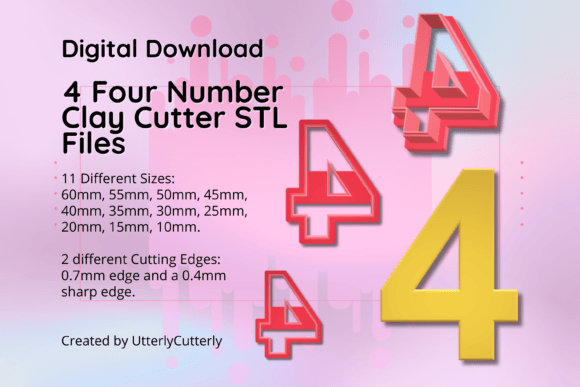
The most common mistake users make with the Clay Cutter STL File Number Four 4 bundle is assuming all included files serve the same purpose. This pack contains two distinct cutting edge profiles, and selecting the wrong one for your material will compromise your final product. You must differentiate between the standard wall and the Sharp Edge (SE) variants based on your application.
- Standard 0.7mm Wall: This cutter features a 0.7mm wall thickness, a 3mm thick base, and a 12mm height. It is robust and durable, making it ideal for cookies, fondant, and thicker air-dry clays. The wider wall provides structural integrity during printing and prevents warping when pressing into denser materials.
- Sharp Edge (SE): Abbreviated as SE in the file names, this variant has a 1mm support wall tapering to a precise 0.4mm cutting edge. Like the standard version, it has a 3mm base and 12mm height. This is specifically engineered for polymer clay earrings and delicate pendants where a clean, crisp cut is mandatory to reduce post-processing sanding.
Using the standard 0.7mm cutter for intricate polymer clay jewelry often results in dragged edges and distorted shapes because the wall is too thick to slice cleanly through soft clay. Conversely, using the SE variant for cookie dough may cause the thin blade to bend or break under pressure. Always verify the file suffix matches your current project material before slicing.
Navigating Size Selection and Measurement Standards
This bundle includes eleven different sizes ranging from 10mm to 60mm (10mm, 15mm, 20mm, 25mm, 30mm, 35mm, 40mm, 45mm, 50mm, 55mm, and 60mm). A frequent point of confusion arises regarding how these dimensions are calculated. The size listed for the Clay Cutter STL File Number Four 4 is measured from the longest ends of the shape, not the width or an average diameter.
If you are designing a pair of earrings and require a specific visual weight, do not assume a 30mm cutter will yield a 30mm wide piece if the number four shape is elongated. Failing to account for this measurement standard leads to mismatched sets or components that are disproportionately large or small for their findings. We recommend printing a single test cutter in your target size and measuring the physical output against your design mockup before committing to a full production run. This simple verification step prevents material waste and ensures your custom cutter combos align with your aesthetic vision.
Critical Considerations for Embossing Details
For creators utilizing the embossing features potentially included in related designs or future updates, understanding tolerance is vital. Any embossing lines in these files are set at 10.5mm tall. Given the total cutter height is 12mm, this leaves exactly 1.5mm of clearance for material displacement.
This means your clay or dough must be thicker than 1.5mm for the embossing to register correctly without bottoming out. If you roll your polymer clay to a standard 1mm or 1.2mm thickness, the embosser will press directly against your work surface, resulting in a flat impression and potential damage to both the cutter and your table. Always condition and roll your material to at least 2mm when using embossing elements to allow for proper depth and definition. This technical constraint is non-negotiable for achieving professional-grade texture.
Printing Parameters for Optimal Performance
Even with the correct file selected, poor slicer settings can render a digital download useless. These STL files are designed to be easily printed, but "easily" does not mean "automatically." To maintain the precision of the 0.4mm SE edge or the structural rigidity of the 3mm base, specific printing parameters should be observed.
- Nozzle Diameter: Use a 0.4mm nozzle for SE files to accurately reproduce the fine cutting edge. A larger nozzle will obliterate the sharp detail. The standard 0.7mm wall files can be printed with either 0.4mm or 0.6mm nozzles.
- Layer Height: Keep layer heights at 0.12mm or lower for the cutting edge portion of the print. Taller layers create a stair-stepping effect that translates to rough cuts in clay. You may increase layer height for the base and handle portions to save time, but the functional edge demands resolution.
- Wall Count: Ensure your slicer is set to print enough walls to match the file design. Printing the SE file with insufficient walls will result in a hollow, fragile blade that snaps immediately. Verify your wall count setting matches the intended geometry.
- Material Choice: PLA is generally sufficient for polymer clay and fondant. However, if you plan to use these for warm cookie dough or dishwasher cleaning, consider PETG or ABS for higher heat resistance. PLA can soften and deform when exposed to warm water or hot dough.
Managing Expectations for Digital Downloads
It is essential to reiterate that the Clay Cutter STL File Number Four 4 is strictly a digital product. You will not receive a physical cutter in the mail. This distinction matters for planning purposes; you need immediate access to a functioning 3D printer or a reliable local printing service. Before purchasing, confirm that your printer’s build volume can accommodate the largest 60mm size plus brim clearance, and that you have the necessary software to open and slice STL files.
Furthermore, while this pack is comprehensive, creative needs evolve. Our store adds new STL files weekly, allowing you to curate unique combinations over time. Rather than searching for a single "perfect" universal cutter, view this Number 4 bundle as a foundational element in a growing library. By mastering the technical nuances of this specific pack—respecting the edge profiles, adhering to thickness tolerances, and optimizing print settings—you establish a workflow that makes integrating future designs seamless and successful. Taking the time to understand these digital assets transforms them from simple files into reliable, professional-grade tools for your creative endeavors.