Clay Cutter STL File Number Five 5: Technical Specifications and Practical Application
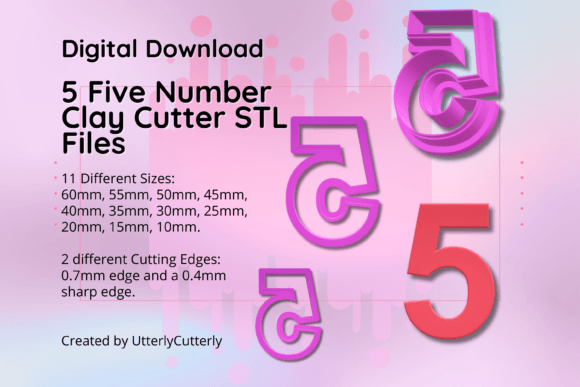
For makers utilizing FDM or resin 3D printing technology, the Clay Cutter STL File Number Five 5 represents a functional digital asset designed for precision crafting. This downloadable bundle provides the necessary geometry to fabricate custom cutting tools specifically optimized for polymer clay, cookie dough, fondant, and other malleable mediums. Unlike generic shape files, this specific number five design has been engineered with manufacturing constraints in mind, addressing common failure points such as warping during printing and insufficient rigidity during use. The value proposition lies not merely in the shape itself, but in the inclusion of dual-edge profiles and an extensive eleven-size gradient, allowing professionals and hobbyists to maintain visual consistency across varying project scales without sourcing multiple disparate files.
Dual-Edge Engineering and Printability
A critical differentiator for the Clay Cutter STL File Number Five 5 is the provision of two distinct cutting edge geometries within the same package. This acknowledges that different materials and finishing requirements demand specific tool characteristics. Understanding these variations is essential for achieving professional results and preventing material waste.
Standard Edge Configuration
The standard cutter variant features a 0.7mm wall thickness with a 3mm thick base and a total height of 12mm. This specification prioritizes durability and ease of post-processing. The thicker wall reduces the likelihood of layer separation when pressing into denser clays or chilled cookie dough. For users printing on standard FDM printers with 0.4mm nozzles, this wall thickness typically translates to two perimeters, creating a robust tool that resists deformation. The 3mm base provides adequate surface area for finger pressure, reducing hand fatigue during repetitive production runs while ensuring the cutter does not flex under load.
Sharp Edge (SE) Variant
Abbreviated as SE in the file naming convention, the Sharp Edge variant utilizes a 1mm support wall tapering to a 0.4mm cutting edge. While maintaining the same 3mm base and 12mm height as the standard version, this profile is engineered for cleaner incisions in softer media like fondant or soft polymer clay. The reduced contact area at the cutting interface minimizes drag and distortion of the material edges. However, users should note that printing a 0.4mm edge requires precise flow rate calibration and optimal cooling to prevent nozzle clogging or edge curling. This variant is best reserved for detailed jewelry work or delicate confectionery where edge definition is paramount.
Dimensional Versatility and Scaling Logic
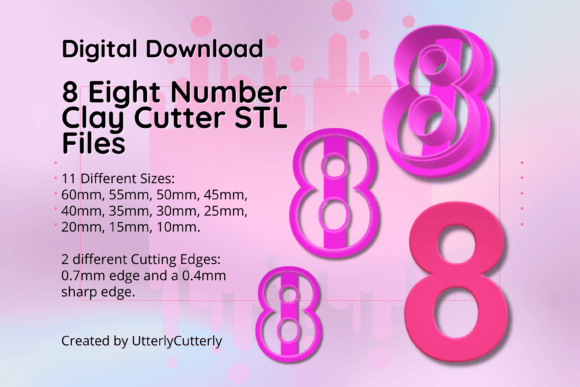
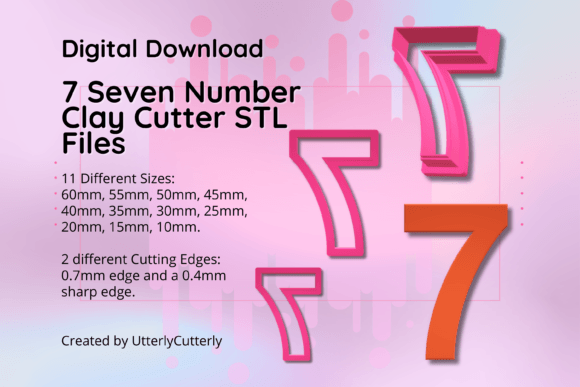
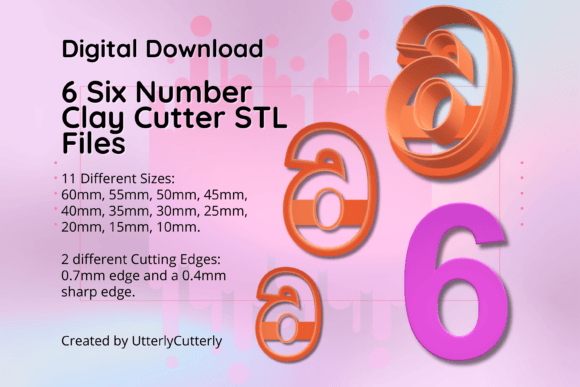
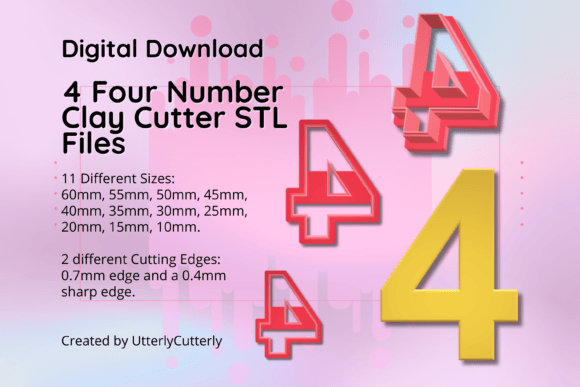
The utility of a digital cutter collection often depends on size availability. The Clay Cutter STL File Number Five 5 bundle includes eleven discrete sizes ranging from 10mm to 60mm. This range covers the majority of applications for earrings, pendants, barrettes, and holiday decorations. Crucially, sizing is measured from the longest ends of the digit, providing a predictable bounding box for layout planning.
- Macro Scale (60mm, 55mm, 50mm): Suitable for large pendant faces, statement brooches, cookies, and festive ornamentation.
- Meso Scale (45mm, 40mm, 35mm, 30mm): Ideal for standard earring components, hair clips, and medium-sized decorative elements.
- Micro Scale (25mm, 20mm, 15mm, 10mm): Designed for stud earrings, charm accents, and intricate detailing work.
Having pre-scaled files eliminates the need for users to resize models in slicer software, which can inadvertently alter wall thickness ratios and compromise structural integrity. By providing native sizes, the designer ensures that the relationship between the cutting edge and the reinforcement base remains constant regardless of the selected dimension. This consistency allows creators to curate custom combos easily, mixing sizes for graduated designs or nesting effects without recalculating print parameters for each iteration.
Embossing Compatibility and Material Considerations
Functional design extends beyond the cutting perimeter. For projects requiring texture, the Clay Cutter STL File Number Five 5 accounts for embossing integration. Any included embossing lines are set to a height of 10.5mm against the 12mm total cutter height. This 1.5mm differential is a deliberate engineering choice. It dictates that the clay slab must be thicker than 1.5mm to accommodate both the cut and the impression without bottoming out.
This specification serves as a practical quality control metric. If a user attempts to use this cutter on clay rolled thinner than 1.5mm, the embossing detail will likely punch through or distort the back surface. Conversely, using clay significantly thicker than 2mm may result in shallow impressions. Makers should condition their clay rolling process to target a 2mm to 2.5mm thickness when utilizing the embossing features of this STL file to ensure crisp, consistent texturing. This level of technical foresight distinguishes purpose-built maker tools from decorative 3D models that lack functional validation.
Workflow Integration and Audience Fit
Evaluating whether this digital asset fits your workflow requires an honest assessment of your equipment and output goals. The Clay Cutter STL File Number Five 5 is most valuable to specific subsets of the maker community:
Small Business Owners and Etsy Sellers: For those producing inventory, the ability to print replacement cutters on-demand mitigates supply chain risks. If a physical cutter breaks or wears out, a new one can be fabricated in under an hour. The size variety also supports product line expansion without additional capital investment in metal tooling.
Educators and Workshop Leaders: Teaching environments benefit from standardized tools. Providing students with identical, high-quality cutters ensures consistent learning outcomes. The digital nature of the file means lost or broken tools do not disrupt lesson plans.
Serious Hobbyists and Freelancers: Individuals experimenting with mixed media or custom jewelry design require flexibility. The weekly release schedule of new STL files from this store suggests an ecosystem approach, where acquiring this number five cutter facilitates future compatibility with complementary shapes and textures.
Practical Limitations and User Expectations
While versatile, this digital download has inherent limitations that users must recognize. First, this is strictly a non-physical item; no tangible cutter will be shipped. Success depends entirely on the user’s 3D printing proficiency. Those without access to a printer or local fabrication service will not derive value from this purchase.
Secondly, print orientation matters. These cutters should generally be printed with the base flat on the build plate to maximize adhesion and minimize support material. However, depending on the printer's bridging capabilities, the internal geometry of the number five shape may require tuning. Users employing resin printers should pay particular attention to hollowing and drainage holes if modifying the base, as trapped resin can ruin the cutting edge.
Finally, material safety is a user responsibility. While PLA and PETG are common for clay cutters, food-safe applications (cookies, fondant) require specific filaments certified for food contact and proper post-print sealing to prevent bacterial growth in layer lines. The STL file provides the geometry, but the user must validate the material safety for their intended application.
Long-Term Value in Digital Fabrication
In the context of digital maker assets, the Clay Cutter STL File Number Five 5 offers sustainable utility. The inclusion of both sharp and standard edges future-proofs the file against changing project needs. A jeweler might primarily use the SE variant for porcelain clay but switch to the standard edge when working with firmer metal clays or wax sheets. Similarly, the comprehensive size range prevents the "just one more size" problem that often plagues digital libraries.
By focusing on manufacturability—specifically wall thickness, base stability, and embossing clearance—this file demonstrates a maturity often missing in free or amateur repositories. For professionals and dedicated enthusiasts, time spent troubleshooting failed prints or deformed cuts is lost revenue or creative momentum. Investing in technically validated STL files streamlines the production pipeline, allowing focus to remain on the artistic execution rather than tool fabrication. As new designs are added to the store weekly, this asset serves as both a standalone solution and a foundational component of a growing, interoperable digital toolkit.