Clay Cutter STL File Surfboard 1- Summer: A Practical Guide to Digital Downloads
The Clay Cutter STL File Surfboard 1- Summer is more than just a seasonal novelty; it is a versatile digital asset designed for creators who value precision and variety. As a symbol for ocean lovers, this surfboard shape serves as a foundational element for summer-themed projects ranging from polymer clay jewelry to fondant cake decorations. However, purchasing a digital download bundle requires a different mindset than buying physical tools. Many makers overlook the technical specifications embedded in STL files, leading to print failures or cutters that do not perform as expected. Understanding the nuances of this specific file pack ensures you can produce professional-grade tools at home without wasting filament or time.
Distinguishing Between Cutting Edge Types
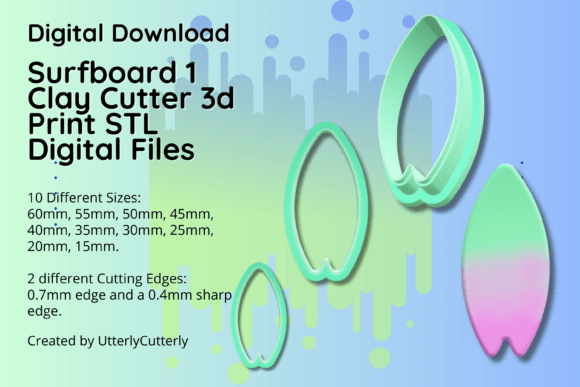
One of the most common mistakes when downloading cutter bundles is assuming all files serve the same purpose. This summer surfboard pack includes two distinct cutting edge variations, and using the wrong one for your specific medium will compromise your results. You must differentiate between the standard wall and the Sharp Edge (SE) variant before slicing.
- Standard 0.7mm Wall: This version features a 0.7mm wall thickness with a 3mm thick base and a 12mm height. It is robust and ideal for cookie dough, thicker fondant, or soaps where durability matters more than razor-sharp precision.
- Sharp Edge (SE): Abbreviated as SE in the file names, this variant has a 1mm support wall but a cutting edge of only 0.4mm. While it shares the same 3mm base and 12mm height, the finer edge is specifically engineered for polymer clay earrings and pendants where clean lines are critical.
Selecting the standard wall for delicate jewelry often results in compressed clay edges that require excessive post-processing sanding. Conversely, using the SE variant for stiff cookie dough may cause the thin blade to warp or break under pressure. Always check the file suffix to match the tool to your material density.
Navigating Size Selection and Measurement Standards
This bundle provides ten sizes ranging from 15mm to 60mm, but misunderstanding how these are measured leads to scaling errors. The size listed for each STL file represents the measurement from the longest ends of the surfboard shape. A frequent oversight occurs when creators assume this dimension refers to the width or the visual center of the design. If you are making matching earring sets, relying on visual estimation rather than the specified longest-end metric will result in mismatched pairs.
Furthermore, avoid the temptation to scale these files arbitrarily in your slicer software. These cutters have been engineered with specific wall-to-base ratios. Scaling a 20mm cutter up to 40mm digitally does not replicate the structural integrity of the native 40mm file; it merely stretches the geometry, potentially making walls too thin or bases disproportionately heavy. To curate custom combos effectively, utilize the provided size increments—60mm, 55mm, 50mm, 45mm, 40mm, 35mm, 30mm, 25mm, 20mm, and 15mm—as they were designed to maintain optimal printability and function at those exact dimensions.
Critical Considerations for Embossing Lines
If your chosen STL file includes embossing details, you must adjust your clay preparation accordingly. The embossing lines in this design are 10.5mm tall. Since the total cutter height is 12mm, this leaves only 1.5mm of clearance for the clay body. Rolling your clay thinner than 1.5mm will cause the embosser to bottom out against your work surface, resulting in flat, undefined details and potentially damaging the cutter's internal structure. Always measure your clay slab thickness with calipers before attempting embossed cuts to ensure the raised design transfers cleanly without mechanical interference.
Optimizing Print Settings for Functional Tools
Even with high-quality STL files, poor printer calibration renders cutters useless. Because these are functional tools subject to lateral pressure, standard decorative print settings are insufficient. Pay close attention to the following parameters to avoid brittle or deformed cutters:
- Wall Count Over Infill: Prioritize perimeter walls over infill percentage. For both the 0.7mm and SE variants, ensure your nozzle diameter aligns with the wall thickness. Printing a 0.4mm SE edge with a 0.6mm nozzle will fail. Use a 0.4mm nozzle or smaller for SE files to guarantee the cutting edge forms correctly.
- Base Adhesion: The 3mm thick base is designed for stability, but it requires proper first-layer adhesion. Insufficient bed leveling or temperature can cause the wide base to lift at the corners, creating an uneven cutting plane that ruins straight lines.
- Material Choice: Not all filaments handle stress equally. PLA is generally sufficient for clay and fondant, but if you plan to use these for denser materials or repeated commercial production, consider PETG or ABS for better layer adhesion and flexibility. Standard PLA can snap if the SE variant is twisted during demolding.
Managing Expectations for Digital Products
It is vital to remember that this is not a physical item. You are acquiring the data required to manufacture the tool, not the tool itself. Before purchasing, verify that you have access to a functioning 3D printer and basic slicing knowledge. Beginners often buy STL bundles expecting immediate utility, only to realize they lack the hardware or technical skills to produce the files. If you are new to 3D printing, start by printing the largest size (60mm) as a test. Larger geometries are more forgiving of minor calibration issues and allow you to validate your printer’s ability to handle the specific wall thicknesses before committing to the tiny 15mm or 20mm jewelry cutters.
Additionally, keep your files organized immediately after download. With new STL files added to stores weekly, digital clutter becomes a significant efficiency drain. Create a dedicated folder structure categorized by size and edge type (e.g., "Surfboard_SE_20mm") rather than leaving generic filenames. This organizational habit prevents accidental reprints and ensures you can quickly locate the exact specification needed for client orders or personal projects.
Versatility Beyond Jewelry Making
While many users acquire the Clay Cutter STL File Surfboard 1- Summer primarily for earrings and pendants, limiting its application to jewelry undervalues the bundle. The larger sizes (45mm–60mm) are exceptionally useful for creating uniform fondant toppers for beach-themed cakes or cutting consistent shapes for shortbread cookies. The 3mm base provides ample surface area for gripping, which is essential when working with sticky food mediums. By recognizing the dual-purpose nature of the size range, you maximize the return on your digital investment. Whether you are crafting barrettes, holiday decorations, or edible art, success lies in respecting the engineering behind the file. Treat these STL downloads as precise manufacturing blueprints rather than generic clipart, and your handmade creations will reflect that level of professional care.