Lifebuoy Earring Charm STL File: A Practical Digital Asset for 3D Printing
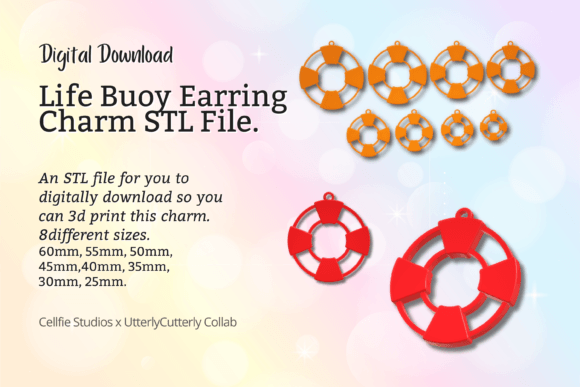
The Lifebuoy Earring Charm STL File represents a specific category of digital manufacturing assets designed for versatility rather than singular application. For makers, small business owners, and hobbyists utilizing FDM or resin 3D printing technology, the value of a digital model lies not just in its aesthetic appeal but in its functional adaptability. This particular digital download provides a comprehensive set of life buoy findings that bridge the gap between vintage nautical aesthetics and modern accessory design. Unlike single-size models that limit utility, this package addresses the practical reality that different end-uses require different scales. By offering eight distinct sizes ranging from 25mm to 60mm, the file eliminates the need for manual rescaling in slicer software, preserving geometric integrity and reducing preparation time for both personal projects and commercial production runs.
Evaluating Design Versatility and Scale Integration
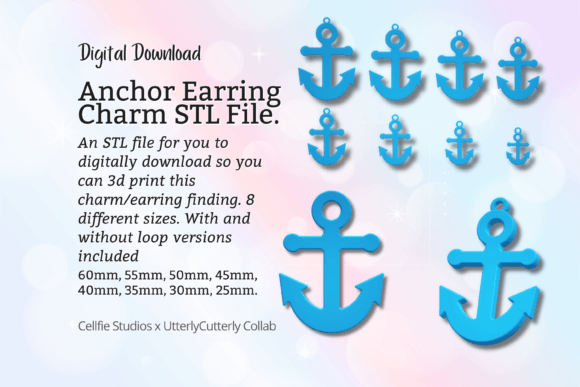
A primary strength of this STL pack is the deliberate inclusion of multiple size variants. In professional 3D printing workflows, resizing a model can sometimes introduce artifacts, distort wall thicknesses, or compromise hole tolerances. Providing pre-sized files ensures that the geometry remains optimized for each specific dimension. The available sizes—60mm, 55mm, 50mm, 45mm, 40mm, 35mm, 30mm, and 25mm—cover a broad spectrum of applications without requiring user intervention.
- 25mm – 30mm: Ideal for lightweight jewelry applications such as stud earrings, delicate pendants, or charm bracelets where weight reduction is critical for wearer comfort.
- 35mm – 45mm: The optimal range for keyrings, bag charms, and zipper pulls. These dimensions provide sufficient surface area for visibility while remaining compact enough for daily carry.
- 50mm – 60mm: Best suited for statement necklaces, wall hangings, Christmas ornaments, or decorative home accents where visual impact takes precedence over portability.
It is important to note that these measurements refer to the main body of the lifebuoy and do not include loop holes. This distinction matters for precision planning; users must account for additional hardware clearance when designing assemblies or selecting jump rings and clasps. The exclusion of integrated loops from the stated measurement suggests a design philosophy focused on modularity, allowing the maker to decide whether to drill post-print, add separate metal findings, or modify the STL to include custom attachment points based on their specific hardware inventory.
Commercial Viability and Production Efficiency
For entrepreneurs and creators selling physical prints, the Lifebuoy Earring Charm STL File offers tangible economic advantages. Nautical themes possess perennial market relevance, particularly in coastal regions, summer retail seasons, and maritime-themed events. However, trend cycles move quickly, and maintaining a diverse product catalog without excessive inventory risk is a common challenge. Digital assets solve this by enabling on-demand manufacturing.
The "modern and vintage" styling described in the product specifications targets a wide demographic. It avoids being overly cartoonish, which limits adult appeal, while remaining accessible enough for younger audiences. This balance makes it suitable for varied sales channels, from Etsy shops and craft fairs to boutique wholesale. Furthermore, because the files are tested as part of a standard quality-checking system, the risk of failed prints due to manifold errors or non-watertight geometry is significantly reduced. For high-volume printers, reliability is a metric as important as aesthetics; every failed print represents wasted filament, resin, electricity, and machine time. Verified, clean geometry directly correlates to higher profit margins and consistent output quality.
Technical Considerations for Optimal Print Quality
While the provider notes that all 3D products are tested before sale, real-world performance depends heavily on individual machine calibration and material selection. Users should approach this file with an understanding of their own printer’s capabilities. The recommendation to amend settings based on specific hardware is not merely a disclaimer but a technical necessity. Layer height, infill density, and support structures will vary depending on whether one is printing a 25mm earring in PLA or a 60mm ornament in PETG.
For jewelry-sized variants (25mm–35mm), surface finish is paramount. Standard 0.2mm layer heights may produce visible stepping that requires extensive post-processing. Users aiming for retail-quality jewelry should consider 0.12mm or lower layer heights, or utilize ironing features if printing with FDM technology. Resin printers offer superior resolution for these smaller sizes but require careful attention to exposure times to prevent loss of detail in thin sections. Conversely, larger ornaments intended for wall hangings prioritize speed and material economy over microscopic detail. Adaptive layering or variable infill can reduce print times significantly for the 50mm+ variants without sacrificing structural integrity.
Orientation also plays a critical role. Lifebuoy shapes typically feature rounded cross-sections. Printing flat against the build plate maximizes adhesion and minimizes support requirements but may necessitate sanding the bottom face. Printing at an angle or vertically can improve surface uniformity on curved faces but increases support contact points. Makers should run test prints of the smallest and largest sizes to dial in orientation strategies before committing to batch production.
Audience Fit and Practical Application Scenarios
Determining whether this digital asset fits your workflow requires honest assessment of your goals and capabilities. This STL file delivers the most value to three distinct user groups:
Small Business Owners and Resellers: If you operate a print-on-demand business or maintain an inventory of handmade accessories, this file provides immediate catalog expansion with zero upfront tooling costs. The multi-size format allows you to create coordinated sets (e.g., matching necklace and earring sets) from a single asset, increasing perceived value and average order value. The licensing terms permitting sale of physical prints make this a legitimate commercial resource rather than a restricted hobbyist file.
Educators and Workshop Leaders: For those teaching 3D printing or jewelry making, this model serves as an excellent intermediate project. It introduces concepts of scale, post-processing, hardware integration, and finishing techniques without overwhelming beginners with complex organic modeling. The range of sizes allows students to choose projects matching their skill level and available materials.
Serious Hobbyists and Gift Makers: Individuals creating personalized gifts benefit from the flexibility to match recipient preferences. A subtle 30mm charm for everyday wear differs significantly from a bold 55mm statement piece for special occasions. Having options within a single download reduces the friction of searching for complementary designs.
Limitations and Realistic Expectations
Potential users should recognize what this product does not include. As a digital download, there is no physical item, no printed sample, and no hardware. Success depends entirely on the user’s equipment, materials, and post-processing skills. Those without access to a 3D printer or willingness to outsource printing will find no direct utility here. Additionally, while the design is described as appealing and versatile, aesthetic preference is subjective. Users should evaluate preview images critically against their target audience’s tastes before purchasing.
The absence of pre-modeled loop holes, while beneficial for customization, adds a step for users who prefer ready-to-assemble components. Drilling small holes in printed plastic requires care to avoid cracking, especially in thinner sections of smaller sizes. Alternatively, users comfortable with CAD modification may wish to add integrated loops before printing. This flexibility is a feature for experienced makers but may present a minor barrier for absolute beginners expecting turnkey solutions.
Finally, while new STL files are added weekly to the store, building a cohesive collection requires ongoing investment. Users should assess whether the existing catalog aligns with their long-term creative or commercial direction rather than making impulse purchases based solely on individual listings.
Final Assessment of Value and Utility
The Lifebuoy Earring Charm STL File succeeds as a practical digital manufacturing resource because it prioritizes functional versatility alongside aesthetic design. The eight-size format demonstrates thoughtful consideration of real-world use cases, from delicate jewelry to substantial decor. Quality assurance through pre-sale testing reduces production risk, while commercial licensing enables entrepreneurial application. For makers seeking reliable, scalable nautical-themed assets that integrate smoothly into existing workflows, this digital download offers measurable utility. Success ultimately depends on matching the file’s capabilities with appropriate printing parameters, post-processing techniques, and realistic expectations about digital-to-physical translation. When those elements align, this asset proves itself a worthwhile addition to any serious maker’s digital library.