Mastering Polymer Clay Jewelry: A Guide to the Tulip 2 STL Cutter Bundle
The intersection of digital fabrication and traditional handcrafts has revolutionized how artisans create jewelry, home decor, and culinary art. At the forefront of this creative evolution is the use of 3D-printed clay cutters, specifically specialized designs like the Tulip 2 Earring and Flower Clay Cutter STL bundle. For makers utilizing polymer clay, metal clay, or even fondant, understanding the technical nuances of these digital files is essential for achieving professional results. This guide explores the practical application, technical specifications, and creative versatility of this specific digital download, ensuring you can maximize your 3D printer’s potential to craft beautiful, unique items for yourself or loved ones.
Understanding Digital Cutter Files in Modern Craft
In the contemporary maker economy, the ability to customize tools is just as important as the artistic skill required to use them. An STL (Standard Tessellation Language) file is the blueprint that instructs a 3D printer on how to construct a physical object layer by layer. When applied to clay cutting, these files represent more than just a shape; they are engineered instruments designed with specific tolerances for slicing through viscous materials.
The Tulip 2 collection exemplifies this engineering precision. Unlike generic cookie cutters found in retail stores, STL files designed for jewelry and detailed crafts account for the delicate nature of polymer clay and the need for clean release. This digital-first approach allows creators to access new designs weekly, curating a personalized toolkit that evolves with their artistic style. Whether you are making earrings, pendants, barrettes, or edible decorations, the digital format ensures you have exact control over size and edge geometry.
Technical Specifications: Choosing the Right Edge
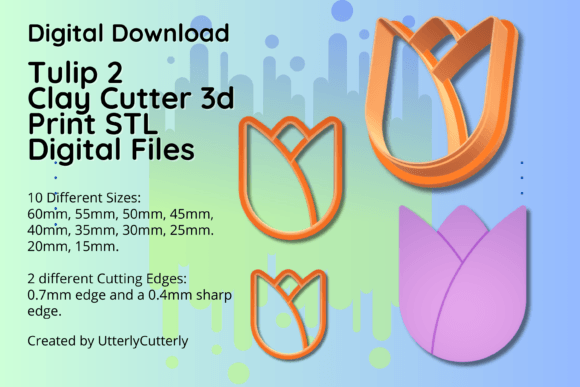
One of the most critical aspects of working with 3D-printed cutters is understanding that not all cutting edges serve the same purpose. The Tulip 2 bundle provides two distinct cutter types within the STL files, each optimized for different stages of creation and material types. Recognizing the difference between these edges will significantly improve your workflow and final product quality.
The Standard Wall vs. Sharp Edge (SE)
This digital pack includes two primary variations to accommodate diverse crafting needs:
- 0.7mm Wall Cutter: This version features a 0.7mm wall thickness with a 3mm thick base and a total height of 12mm. This robust design is ideal for general shaping, creating outlines in softer clays, or when structural rigidity is needed during the pressing phase. The thicker wall reduces the risk of the cutter warping under pressure.
- Sharp Edge (SE): Abbreviated as "SE" in the file names, this variant boasts a 1mm support wall tapering to a precise 0.4mm cutting edge. With the same 3mm base and 12mm height, this cutter is engineered for clean, crisp slices through polymer clay. It minimizes drag and distortion, making it the superior choice for intricate earring components where a smooth perimeter reduces post-processing sanding time.
Note on Embossing: If your chosen design includes embossing lines, they are calibrated to be 10.5mm tall. To ensure the embossed detail transfers correctly without bottoming out, always work with clay that is conditioned to a thickness greater than 1.5mm. This technical constraint is vital for maintaining depth and definition in textured floral designs.
Versatility Through Size Variation
A common misconception among beginners is that a single cutter size suffices for all projects. However, professional jewelry making relies heavily on scale variation to create visual hierarchy and fit different anatomical placements. The Tulip 2 bundle addresses this by providing 10 distinct sizes, measured from the longest ends of the design.
The available dimensions include:
- 60mm – Ideal for statement pendants or large decorative cookies.
- 55mm – Suitable for bold barrettes or oversized earrings.
- 50mm – A versatile mid-large size for necklaces.
- 45mm – Perfect for standard dangle earrings.
- 40mm – Great for stud earrings or smaller charms.
- 35mm – Delicate jewelry components.
- 30mm – Miniature accents and toddler-sized accessories.
- 25mm – Tiny details for mixed-media art.
- 20mm – Micro-jewelry and fine embellishments.
- 15mm – The smallest scale for subtle texture or bead caps.
Having this gradient of sizes allows you to curate custom combos easily. You might pair a 45mm tulip with a 20mm bud to create an asymmetrical earring set, or use the 60mm version for a fondant cake topper while using the 30mm version for matching cupcake decorations. This scalability transforms a single digital asset into a comprehensive design system.
Practical Applications Beyond Jewelry
While the Tulip 2 STL is marketed heavily toward earring and pendant makers, its utility extends well beyond the jewelry bench. The food-safe nature of many 3D printing filaments (such as PLA) makes these cutters excellent for culinary arts, provided proper hygiene protocols are followed.
Fondant and Cookie Decoration: The sharp edge (SE) files are particularly effective for rolled fondant and sugar cookies. The 0.4mm blade cuts through sugary doughs without tearing, preserving the intricate petal details of the tulip design. Because the cutters come in sizes down to 15mm, they are perfect for creating detailed floral borders on wedding cakes or petite tea-party treats.
Gift Creation: The ability to produce consistent, high-quality shapes makes these cutters invaluable for small business owners or hobbyists creating gifts. Whether producing a batch of matching bridesmaid jewelry or personalized holiday cookies, the repeatability offered by a precision-printed STL file ensures every piece meets the same standard of excellence.
Optimizing Your 3D Print for Success
Since this is a digital download and not a physical item, the quality of your final tool depends entirely on your printer settings. Our cutters are designed to be easily printed, but adhering to best practices will extend the life of your tools.
- Layer Height: Print at 0.12mm or lower for the sharpest possible edge definition, especially for the SE variants.
- Infill: Use 100% infill or at least 4-5 perimeter walls. Hollow cutters lack the rigidity needed to press into stiff clay and may crack.
- Orientation: Always print cutters with the base flat against the build plate. Never print on the cutting edge, as layer lines will transfer directly to your clay.
- Material Choice: Standard PLA is sufficient for polymer clay and fondant. For abrasive materials or higher durability, consider PETG or ABS, though PLA generally offers the sharpest edge resolution due to faster cooling.
Building a Sustainable Creative Practice
Investing in digital STL files represents a shift toward sustainable, on-demand manufacturing. Instead of shipping plastic tools across oceans, you utilize local fabrication to create exactly what you need, when you need it. The Tulip 2 bundle is part of a broader ecosystem where new STL files are added to the store every week. This continuous expansion encourages makers to experiment with new aesthetics without accumulating physical clutter.
Furthermore, owning the digital file grants you autonomy. If a cutter breaks or wears out after months of heavy use, you can simply reprint it. If you decide to start a new product line featuring miniature florals, the 15mm and 20mm files are already in your library. This flexibility is the hallmark of modern digital craftsmanship, bridging the gap between technological capability and human creativity.
Conclusion
The Tulip 2 Earring and Flower Clay Cutter STL bundle is more than a simple shape file; it is a comprehensive toolkit for the modern artisan. By offering dual edge profiles, ten precise sizes, and applications ranging from high-fashion jewelry to culinary decoration, it empowers creators to execute their vision with accuracy and flair. As you download and print these files, remember that the technology serves the art. Experiment with the different sizes, test both the standard and sharp edges, and discover how digital precision can elevate your handmade creations to new heights of professionalism and beauty.