Mastering Polymer Clay and Baking Projects with the Clay Cutter STL File Number Zero 0
The intersection of digital fabrication and traditional handcrafts has revolutionized how artisans approach design, particularly in the realms of jewelry making and culinary arts. For creators utilizing 3D printing technology, access to precise, scalable, and versatile tools is paramount. The Clay Cutter STL File Number Zero 0 represents a significant advancement in this niche, offering a comprehensive digital bundle designed specifically for the production of earrings, pendants, barrettes, cookies, fondant work, and seasonal decorations. Unlike generic shapes, this specialized zero numeral cutter addresses specific typographic needs in crafting, allowing for personalized monograms, anniversary dates, and mathematical or symbolic designs that require crisp, accurate geometry.
This digital download provides immediate access to a suite of manufacturing files, eliminating shipping wait times and allowing makers to iterate on designs instantly. Whether you are a professional jeweler seeking consistent sizing for a product line or a home baker creating custom holiday treats, understanding the technical specifications and application methods of these STL files ensures optimal results across different mediums.
Technical Specifications and Print Optimization
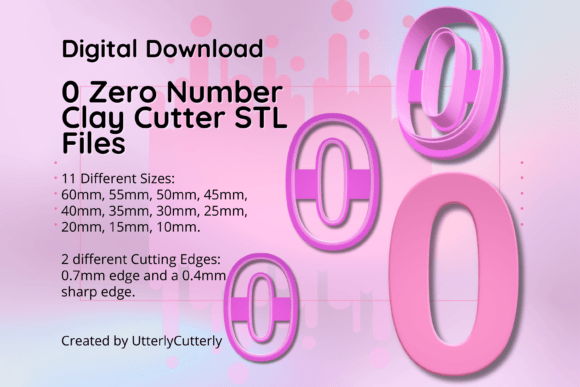
Achieving functional cutters from an STL file requires more than simply hitting print; it demands an understanding of how wall thickness and edge geometry interact with materials like polymer clay, dough, and resin. This specific bundle includes two distinct cutter profiles engineered for different outcomes. Both variations share a robust 3mm thick base and a standard height of 12mm, providing structural integrity during the cutting process while remaining low-profile enough for easy storage and handling.
The Standard Wall Configuration
The first variation features a 0.7mm wall thickness. This specification is ideal for general-purpose cutting where durability is prioritized over extreme sharpness. The 0.7mm wall offers sufficient rigidity to prevent flexing when pressing through denser clays or stiff cookie doughs. This version is particularly recommended for users printing with PLA or PETG at standard layer heights, as it balances print speed with functional longevity. The wider wall also makes post-processing easier if sanding is required to smooth out layer lines.
The Sharp Edge (SE) Variant
For projects requiring high-definition detail, the bundle includes the Sharp Edge variant, abbreviated as SE in the file naming convention. This design utilizes a 1mm support wall that tapers down to a precise 0.4mm cutting edge. This geometry mimics commercial metal cutters, providing a cleaner slice through soft polymer clay and reducing drag. The SE variant is essential for intricate jewelry components where edge definition directly impacts the final aesthetic after baking. However, users should note that the thinner cutting edge may require slower print speeds and careful retraction settings to prevent nozzle clogging or edge deformation during the printing process.
Dimensional Versatility Across Eleven Sizes
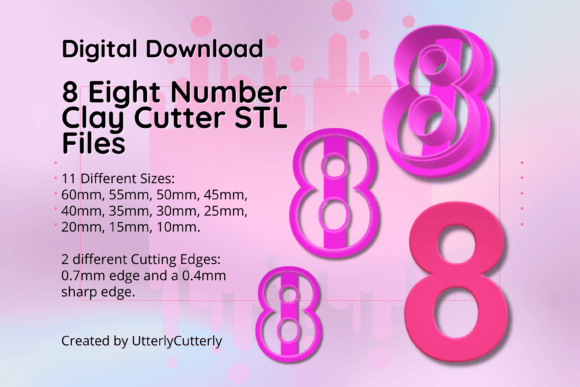
One of the primary advantages of digital cutter libraries is the ability to maintain proportional accuracy across multiple scales. Physical cutter sets often suffer from inconsistent stroke weights when scaled up or down, but the Clay Cutter STL File Number Zero 0 maintains geometric fidelity across all eleven included sizes. Measured from the longest ends, the available dimensions are:
- 60mm: Ideal for large statement pendants, cake toppers, or oversized holiday ornaments.
- 55mm & 50mm: Perfect for substantial barrettes, keychains, or decorative cookie borders.
- 45mm & 40mm: Versatile mid-range sizes suitable for standard earrings and medium fondant accents.
- 35mm & 30mm: Commonly used for charm bracelets, smaller earring studs, and cupcake toppers.
- 25mm & 20mm: Delicate sizes for micro-jewelry, nail art embellishments, or petit four decorations.
- 15mm & 10mm: Specialized miniature applications for detailed mosaic work or tiny accent pieces.
This granular size progression allows creators to curate custom combos easily. For example, a jeweler might use the 40mm and 15mm versions together to create a nested earring design, while a baker could utilize the 60mm and 30mm cutters to create tiered cookie stacks. Having all sizes in a single digital pack ensures that the font weight and curvature remain harmonious regardless of which combination is selected.
Embossing Integration and Material Depth
Beyond simple outline cutting, many advanced clay projects incorporate texture and depth. Users working with this STL bundle must be aware of the embossing line specifications. If the design includes internal embossing details, they are set at a height of 10.5mm. Given the total cutter height of 12mm, this leaves a 1.5mm clearance.
This measurement is critical for material preparation. To achieve a clean impression without bottoming out or distorting the clay, your rolled material must be thicker than 1.5mm. Working with clay thinner than this threshold will result in the embossing feature pressing completely through the material or failing to register clearly. For polymer clay artists, this typically means rolling to a 2mm or 3mm setting on a pasta machine before cutting. For bakers using fondant or gum paste, ensuring adequate thickness prevents tearing and allows the embossed number to retain its shape during drying.
Applications in Jewelry and Culinary Arts
The utility of the number zero shape extends far beyond simple arithmetic. In the context of gift-giving and commercial product creation, this shape serves as a foundational element for personalization.
Jewelry and Wearable Art
In jewelry design, the zero is frequently used to represent milestones such as "Year Zero," new beginnings, or specific dates like 2020 or 2030. The availability of both sharp and standard edges allows makers to choose the appropriate finish for their target market. The Sharp Edge (SE) files produce jewelry-ready edges that require minimal sanding, preserving the maker's time and reducing material waste. When creating barrettes or hair clips, the larger 50mm-60mm sizes provide ample surface area for additional embellishments, paint, or gold leaf application.
Culinary and Seasonal Decorations
For bakers and confectioners, consistency is key. Digital STL files ensure that every cookie or fondant piece is identical, which is crucial for packaging and professional presentation. The number zero is indispensable for birthday cakes, anniversary celebrations, and New Year's Eve events. Because these cutters are designed to be easily printed, a bakery can download the file and produce fresh cutters for a specific event within hours, rather than sourcing specialized metal tools that may not arrive in time. The food-safe nature of the finished print depends entirely on the user's filament choice and post-processing sealing methods, but the geometry itself is optimized for clean release from dough and fondant.
Best Practices for Digital Fabrication
To maximize the performance of the Clay Cutter STL File Number Zero 0, users should adopt specific workflow habits. Since this is a digital download and not a physical item, the quality of the final tool rests on printer calibration. It is advisable to print a test cutter in the 30mm size before committing to a full batch. Check the inner walls for layer adhesion issues, especially on the SE variant. If the 0.4mm edge appears rough, consider adjusting cooling fan speeds or switching to a hardened steel nozzle for better precision.
Furthermore, because new STL files are added to the store weekly, maintaining an organized digital library is beneficial. Creators should categorize files by type (Standard vs. SE) and size to streamline the selection process during active production. This organizational habit pairs well with the modular nature of the collection, allowing for rapid prototyping of new gift ideas or seasonal products.
Ultimately, this bundle serves as a bridge between digital design and tactile creation. By providing eleven distinct sizes and two specialized edge profiles, it empowers professionals and hobbyists alike to produce high-quality, customized items with efficiency and artistic control. Whether crafting a delicate pair of polymer clay earrings or a festive array of numbered cookies, the precision embedded in these STL files translates directly to the excellence of the finished handmade good.