Clay Cutter STL Circle Drop 4: A Practical 3D Print Resource for Makers
The Clay Cutter STL Circle Drop 4 - 3d Print represents a functional intersection between digital fabrication and traditional handcraft. For makers who operate 3D printers not just as prototyping tools but as manufacturing units for small business or serious hobbyist work, the quality of STL files is paramount. This specific digital download bundle offers a comprehensive solution for creating circular drop shapes, addressing common pain points in polymer clay, fondant, and cookie decoration. Rather than offering a single static shape, this package provides a scalable system designed for versatility, allowing users to produce consistent results across various mediums without requiring extensive CAD modeling skills.
Technical Specifications and Design Variants
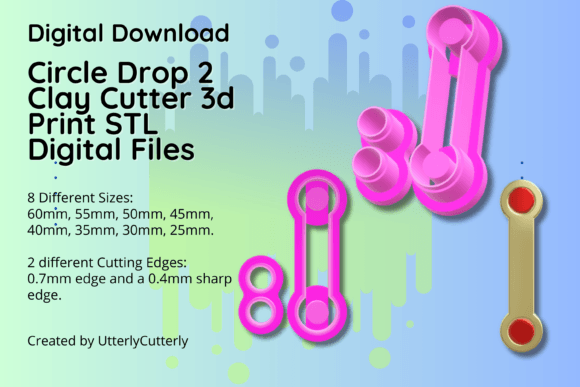
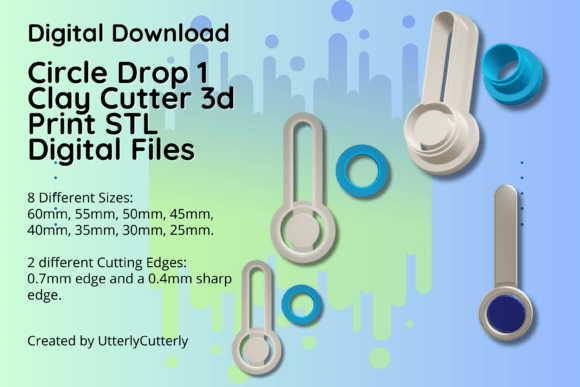
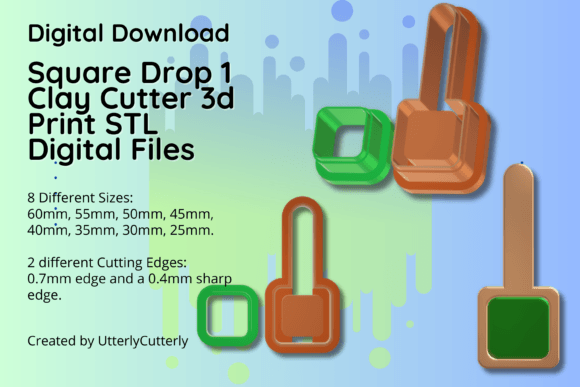
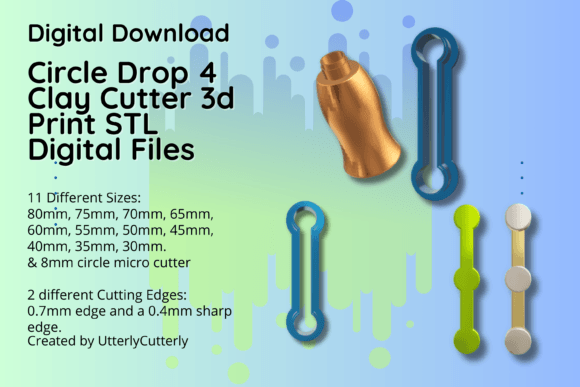
Understanding the technical parameters of an STL file is essential before committing print time and filament. The Clay Cutter STL Circle Drop 4 is engineered with two distinct cutting edge profiles to accommodate different material viscosities and finishing requirements. This duality significantly increases the utility of the pack compared to single-profile alternatives.
- Standard Wall Profile: Features a 0.7mm wall thickness with a 3mm thick base and a total height of 12mm. This robust design is ideal for stiffer materials like ceramic clay or dense cookie dough where structural integrity during the pressing motion is necessary to prevent warping.
- Sharp Edge (SE) Profile: Abbreviated as SE in the file names, this variant includes a 1mm support wall tapering to a precise 0.4mm cutting edge. It shares the same 3mm base and 12mm height specifications. The sharper geometry is optimized for polymer clay and fondant, providing cleaner cuts that require minimal post-processing or sanding.
The inclusion of both profiles acknowledges that makers rarely work with a single medium. The 12mm height is a deliberate ergonomic choice; it provides sufficient surface area for finger pressure while maintaining enough rigidity to resist flexing. The 3mm base acts as a stabilizer, ensuring the cutter remains perpendicular to the work surface, which is critical for achieving uniform thickness in jewelry components or baked goods.
Size Gradation and Workflow Efficiency
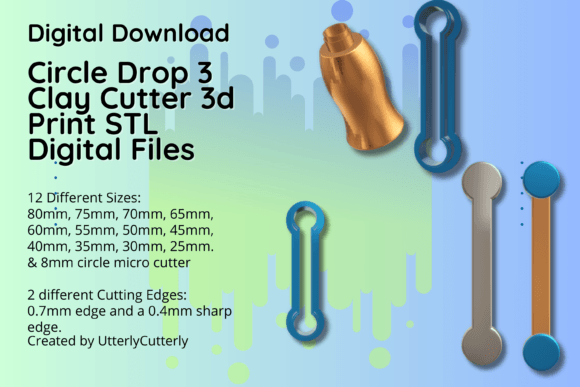
Consistency in sizing is often the most challenging aspect of handmade production. This bundle mitigates that risk by providing 11 incremental sizes ranging from 30mm to 80mm. The specific gradations (30, 35, 40, 45, 50, 55, 60, 65, 70, 75, and 80mm) allow for precise nesting and collection curation.
For jewelry makers, this range facilitates the creation of cohesive product lines. An artisan can produce a statement pendant at 80mm and matching stud earrings at 30mm using the exact same geometric proportions. The circle micro cutter component, which produces an 8mm wide square, serves as a specialized connector or earring backing element. This integration of findings-making tools within a shape-cutter bundle streamlines the production workflow, reducing the need to source separate metal hardware for every design iteration.
Practical Applications Across Mediums
While marketed primarily toward clay artists, the utility of the Clay Cutter STL Circle Drop 4 extends into culinary and textile arts. The digital nature of the asset means the user defines the application through material choice and print settings.
Polymer Clay and Jewelry Fabrication
In jewelry applications, the Sharp Edge (SE) files are typically superior. Polymer clay tends to drag against thicker walls, causing distortion. The 0.4mm edge slices cleanly, preserving the intended silhouette. The included earring backings and dangle connectors enable creators to fabricate entirely custom hardware, moving beyond generic store-bought components. This level of customization is a significant value proposition for sellers on platforms like Etsy, where unique design elements differentiate products in a saturated market.
Culinary Uses: Cookies and Fondant
When transitioning to food-safe applications, users must prioritize safety protocols. While PLA is generally considered food-safe in composition, 3D printed parts have layer lines that can harbor bacteria. For cookie dough and fondant, it is standard professional practice to use these cutters with a barrier method (such as plastic wrap) or to seal the printed part with a food-safe epoxy resin. The Standard Wall profile is preferable here, as the sharper SE edge may be too delicate for stiff chilled dough and could fracture under higher pressure.
Evaluating Printability and File Quality
A major advantage of this specific STL bundle is its design for ease of printing. Many free or low-cost cutter files suffer from non-manifold geometry, thin walls that fail to slice correctly, or excessive overhangs requiring supports. The Clay Cutter STL Circle Drop 4 avoids these pitfalls through intentional design constraints.
The 3mm base ensures excellent bed adhesion, reducing the likelihood of print failures on the first few layers. The 12mm height strikes a balance between functionality and print speed; taller cutters consume more filament and time without necessarily offering better performance. Furthermore, the files are oriented for optimal printing, minimizing the need for support structures that leave blemishes on the cutting edge. For users with entry-level FDM printers, this reliability reduces waste and frustration.
If there are any embossing lines present in the design, they are integrated directly into the mesh rather than added as post-process textures. This ensures that registration marks or alignment guides remain consistent across all 11 sizes, a detail often overlooked in less rigorous digital assets.
Strategic Value for Creators and Small Businesses
For entrepreneurs and freelancers, the return on investment for digital assets is measured in time saved and product consistency achieved. Purchasing the Clay Cutter STL Circle Drop 4 eliminates the learning curve associated with designing functional cutters from scratch. CAD modeling for thin-walled functional parts requires specific knowledge of tolerances and printer capabilities; this bundle outsources that technical complexity.
Additionally, the weekly release schedule mentioned by the provider suggests an active development pipeline. For businesses building a brand around specific aesthetic themes, access to regularly updated, stylistically consistent STL files allows for rapid inventory expansion without hiring a dedicated designer. The ability to curate custom combos using these standardized sizes enables agile responses to seasonal trends or customer requests.
Considerations and Limitations
Despite its strengths, prospective users should approach this resource with realistic expectations. Digital files require local hardware competency; successful outcomes depend on proper printer calibration, nozzle selection, and material quality. A 0.4mm nozzle is generally recommended for the SE files to accurately reproduce the thin cutting edge, whereas a 0.6mm nozzle might suffice for the standard profile but could compromise detail.
Furthermore, while the size range is extensive, specific niche requirements may fall outside the 30-80mm spectrum. Users needing miniature components below 30mm or large-scale decorative elements above 80mm will need to supplement this pack. However, as a foundational library item, the Clay Cutter STL Circle Drop 4 covers the most statistically relevant sizes for wearable art and standard confectionery.
Integration into Creative Workflows
Ultimately, the value of this 3D print bundle lies in its role as a reliable production tool. It transforms a generic 3D printer into a specialized manufacturing device for creative goods. Whether producing high-margin polymer clay jewelry or bespoke event decorations, the precision and variety offered by these files support professional-grade output.
Makers evaluating this resource should consider their current bottlenecks. If inconsistency in shape, excessive time spent on post-processing rough cuts, or limitations in available hardware designs are hindering growth, this STL pack addresses those specific friction points. By standardizing the cutting process, creators can focus their energy on surface design, assembly, and marketing, confident that the underlying form factor is reproducible and precise. The combination of dual-edge profiles, comprehensive sizing, and integrated jewelry findings makes the Clay Cutter STL Circle Drop 4 a pragmatic addition to any digital maker’s library.